
Collecting for the Future
How does a museum build a collection? Why do museums choose specific objects to steward for future generations? Explore these questions and more in this special video blog.
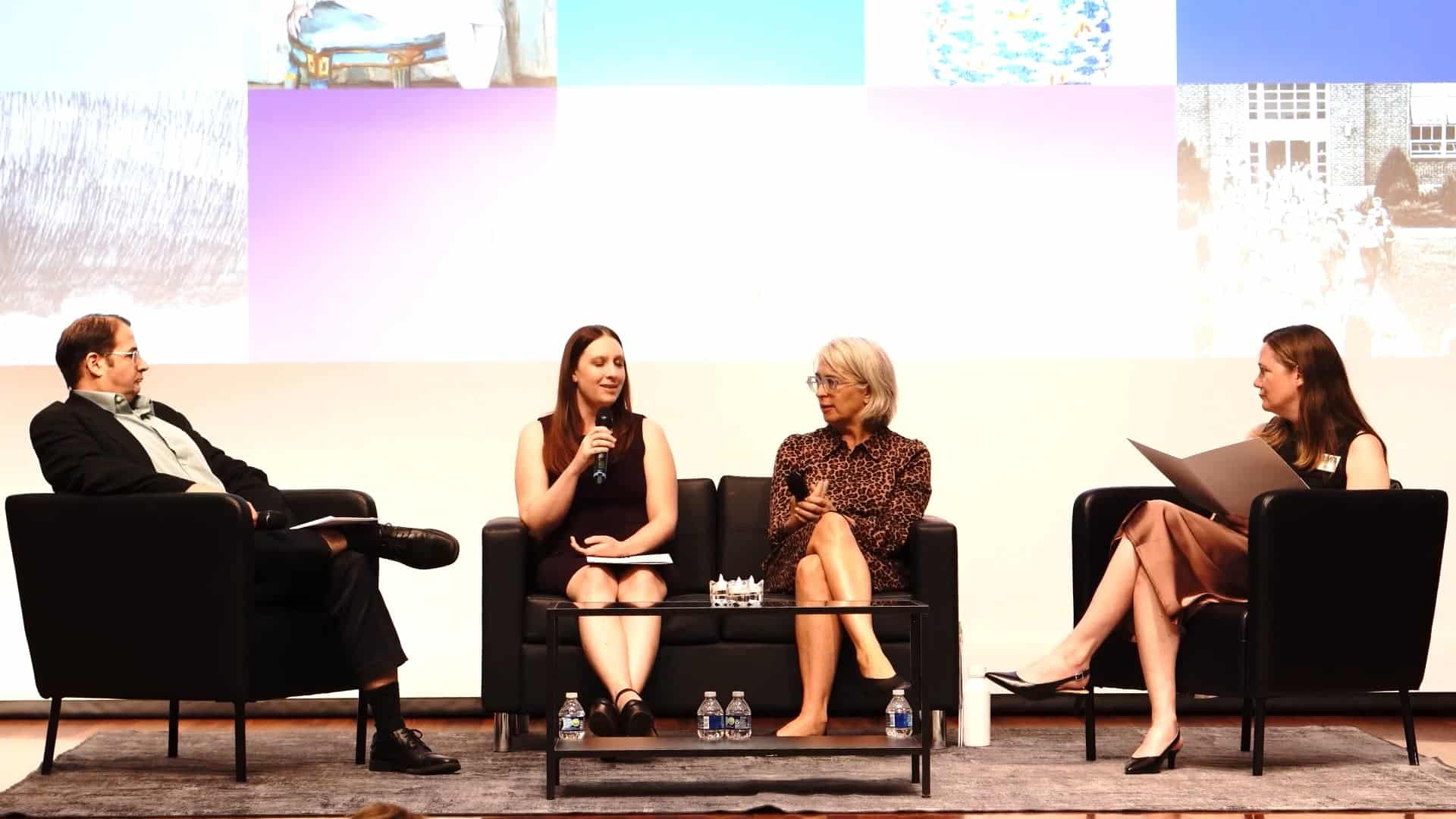
In this special talk, recorded September 16, 2026, curators and the executive director of the Utah Museum of Fine Arts give behind-the-scenes insights into the objects the Museum collected between 2001–2026.
Watch the full recording or read the transcript below.
Opening Remarks by Ashley Farmer
Hi, good evening everyone. My name is Ashley Farmer and I’m co-director of learning and engagement here at the Utah Museum of Fine Arts.
Before this evening’s program, I would like to acknowledge that the UMFA is situated on land which is named for the Ute Tribe and is the unseated traditional and ancestral homeland of the Shoshone, Paiute, Goshute and Ute tribes. The University of Utah and the UMFA acknowledge the significance of place and the continued existence and contributions of indigenous people who have lived on and cared for the land for thousands of years. We respect the sovereign relationship between tribes, states, and the federal government, and we affirm the University of Utah’s commitment to partnership with native nations and urban Indian communities through research, education, and community outreach.
Thank you for joining us for Collecting For the Future, a unique glimpse into some beloved works of art from the perspective of my fantastic colleagues. This program is connected to our latest special exhibition at the UMFA, For the Future, which celebrates the 25th anniversary of the Marcia and John Price Museum building and showcases some of the UMFA’s most notable art acquisitions of the past 25 years. If you haven’t had an opportunity to spend time in the exhibition, we invite you to do so afterwards. And even if you have, it bears another visit or two or three. This exhibition was made possible by presenting sponsor, the John and Marcia Price Family Foundation, as well as the Tozer Endowment for Special Exhibitions and the JT Harwood Collections Fund. We’re also grateful to the University of Utah, the Beverly Taylor Sorenson Foundation, and the Willard L. Eccles Charitable Foundation for their support of programs like these.
So in terms of this evening, we’ll hear briefly from each of our four presenters who will share a story about how significant works of art and collections have come into the UMFA. Afterwards, they’ll gather on stage. Well, they’re gathered here, but they’ll continue to be gathered here on stage for a conversation and then we’ll have an audience Q&A. And thanks to everyone who submitted questions ahead of time. Those are great. So now I’ll introduce my four brilliant colleagues who as a team of curators conceived of For the Future and whose vision will carry us into all that lies ahead.
Gretchen Dietrich is the Marcia and John Price Executive Director of the Utah Museum of Fine Arts, serving in the position since 2009. Dietrich began her career more than 35 years ago as a museum educator and has held positions at the Wadsworth Athenea Museum of Art in Hartford, the Isabella Stewart Gardner Museum in Boston, and the Philadelphia Museum of Art. From 2015 to 2018, Dietrich served on the board of the Association of Art Museum Directors and oversaw the AAMD’s Education and Community Issues Committee. Since 2019, she has served on the board of directors of the Art Bridges Foundation, an organization dedicated to expanding access to American art across the country.
Dr. Alisa McCusker is senior curator and curator of European and American Art at the UMFA. She is a specialist in renaissance art and works on paper and has curated and co-curated numerous exhibitions on a range of topics, including on medieval and early modern book illustration, Japanese woodblock prints, American regionalism, and contemporary art in the American West. Previously, she served as curator of European and American art at the Museum of Art and Archeology at the University of Missouri. She holds a doctorate in art history from the University of Texas at Austin and a Master of Arts in Art History and Museum Studies from the joint program between Case Western Reserve University and the Cleveland Museum of Art. She received a Fulbright full year fellowship to Germany for her dissertation research.
Dr. Emily Lawhead is curator of modern and contemporary art at the UMFA. She holds a BA in comparative cultural studies from Northern Arizona University, a master’s in museum studies from the University of San Francisco, and a PhD in the history of art and architecture from the University of Oregon. Her research explores intersections of art and technology with recent publications on topics including interactive digital art, immersive exhibitions, and the history of AI art. At the UMFA, Emily spearheads the salt exhibition series, excited to have one opening quite soon, site specific commissions in the great hall and the museum’s vibrant photography, New Media, and Modern and Contemporary art collections.
Luke Kelly is the associate curator of collections at the UMFA. In his 25th year at the museum, he oversees the Asian and archeological collections. Luke has curated small and large scale shows from the Asian and Asian American collections, including the 2020 exhibition Beyond the Divide, exploring Edo period Japanese art and the 2024 installation Chiura Obata: Layer by Layer, celebrating the discoveries within the artist’s horses screen.
So please join me in welcoming our four presenters for the evening and I’ll turn it over to them.
Imperial Bat and Cloud Vase Presented by Luke Kelly
Good evening. How many people does it take to create a masterpiece? No, that’s not a bad joke. One? Five? Ten? Twenty?
In the case of this Imperial Bat and Cloud Vase from the mid 18th century, it took roughly 80 people from start to finish.
It was created for this man, the Qianlong emperor, probably most likely as a gift for him to give to one of his associates. He ruled the China for 60 years over the 400 year Qing dynasty. He was a great patron of arts in China with one foot formally set in the past, collecting great art from previous Chinese dynasties. The Palace Museum at Beijing and Taipei attest to his collecting prowess, but he also had one foot set in the future, very enamored and fascinated with new techniques from the West, particularly European style portraiture, which you can see here, he has a cheeky title called “Is It One or Two?” As he’s sitting for a portrait, you can see above there’s another portrait of him done in the European style.
But the creation of this vase came down to this man, Tang Ying. He was a superintendent of the Imperial Kilns a Jingdezhen. He did the unique job, the unique task of actually moving to the city, not staying behind in Beijing, spending three years living with the workers and learning the porcelain making process. It was he who decided the best way to create porcelain for the imperial family was to divide the process up into those 80 steps. Each step would have one artisan trained specifically for that task, whether it be throwing the vase, painting the cobalt.
Science today neatly explains the creation of a porcelain piece with exact ratios of the raw materials, the necessity of the kiln reaching 1300 degrees centigrade for the glaze to harden, for it to make the translucent hard white body and the brilliant cobalt blue decoration. I would argue though in the mid 18th century, it was more alchemy. There are no recipes. These secrets were handed down from one generation to the next. Secrets like if you add too much iron to the glaze, you’re not going to get the white, you’re going to get a yellowish white, which will really just ruin the piece. Perhaps the most tedious but most important task fell to the person who had to watch the kiln fire. How do you measure 1300 degrees centigrade without a thermometer? He only had his eyes and the feel of the kiln.
But when the vase was removed from the kiln, which revealed the brilliant white body and the underglazed cobalt blue painting, it was not yet finished. It was then given to a second artisan who applied iron red enamel, a technique brought from Europe to paint the bats onto the vase. It once again then went under a second firing, a lower degree one to fix the color to the vase. So for all this intensive effort, which in most likely took more than three months, including the most arduous part of the creation, the journey, Jingdezhen is 900 miles away from Beijing. There are rivers, there are roads, but they did not have art movers back in the day. They had cloth and straw to carry this vase over 900 miles. So for all of this intensive effort, what was its purpose for the Qianlong Emperor?
Well, it has this funny little message because in the spoken Chinese language, bat and luck happiness sound similar. So this vase that the Qianlong Emperor gave to someone basically was saying, “May your luck or happiness be as high as the clouds.”
If you saw the first openings shot where it had the accession number, UMFA 2014, it actually has a story going back 50 years before that. A collector came to the museum in 1973 to meet Frank Sanguinetti. His name was Burt Cliff and he’d quietly been collecting Imperial Qing porcelain for 20 years. Working with Frank, they staged this 1974 exhibition with pieces from his collection. It was the first time a museum in Utah showed imperial Chinese porcelain. Over the next two decades, Burt Cliff continued to acquire pieces, growing his collections with acquisitions from major galleries in London, Paris, New York, as well as auction houses. Our museum would hold temporary exhibitions in the old building, and it was during this time Burt Cliff made first a verbal promise and then a written promise that on his death, his collection would come to the museum as a bequest. His last purchase came in 2004. Burt told me that the market was quickly growing out of his reach. East Asian millionaires and billionaires were now the new audience and stories of Imperial Qing porcelain going for 10 to 20 times their auction estimates were quite common. After his death in 2013, his bequest of over 200 porcelain works and paintings became a transformational gift for the museum and our Asian art collection, putting us on par with major museums across the country. It is a collection that very few individuals or museums could create today, let alone a quiet collector from West Valley City.
Thank you.
New Acquisitions Presented by Gretchen Dietrich
Well, good evening everyone. Welcome. Can we just say another round of applause for Luke for being part of our staff for 25 years? That is so incredible and we’re so lucky to work with you, Luke, every day. Thank you.
So this exhibition, I’ve been joking could be called art that Gretchen loves, like really loves. And it’s been such a pleasure to sort of do this together and to explore the collections and very challenging actually to pick just, I think we have 41 objects in the show, to pick just 41 things to put in this exhibition.
So I want to share just a few stories about art that I really love, and it’s because I really loved it and I kind of wouldn’t stop talking about it with curators that it’s here in our collection. This one is a real winner, Melissa Cody’s Scaling the Caverns made in 2023, acquired by us very recently. And it’s almost seven and a half feet tall if you haven’t seen it yet in the exhibition. And it’s the first time that it’s ever been on view since we acquired it. So that’s pretty exciting.
And I just thought it would be sort of interesting to share just sort of how these three objects kind of made their way here into the collection. And as I said, the thing they have in common is that they are artists and artworks that I encountered in the world. And I think art is very subjective. Yes, what I like, you may not. What you love, I may not. That’s the way that goes. But as curators, our job is to find art and artists that we think are important and will continue to make important works of art and that their objects will sort of add to the collection here and enhance the works that we already have and hold in the collection. And that’s a sort of interesting thing just in thinking about this exercise, acquiring one work of art and the much broader story of creating a collection over time, right? It’s a tricky endeavor. I think one of the things that we do as curators and art museum people is an awful lot of looking. And I will say that I sometimes feel kind of guilty that I basically get paid to go places and visit art museums and galleries because that’s pretty fun, but that is what we do and it is really important and I’ve been doing it a long time.
So art and art history, in addition to that and to the joy and pleasure of our jobs that I think we’re very grateful for, it is also a discipline, right? There’s stuff to know and there’s stuff to study and there are people to talk to and there is a building of knowledge I think with our colleagues and liking it or not liking it and in some case loving it a lot is all part of it. But I’ve been doing this as, as Ashley told you for a long time, 36 years of looking at art as a professional art museum person and you do kind of learn some things I think. And sometimes you make mistakes and sometimes you get it right and don’t ask in the Q&A what have been the mistakes. I won’t say. But once we see something we love, we come back to Utah and we tell each other about it and we show pictures of it to each other and we do research and we encourage each other to read and look into these artists and lots of conversation, lots of research. And then sometimes the stars align and that’s a whole nother conversation about sort of what you can get your hands on when and what you can afford and all of that. But sometimes the stars align and we’re able to bring something into the collection.
So this worked for me, and I’ll just show you this lovely photo of Melissa on the right working. And then this is our piece on the left, a photographed by me in PS1, MoMA PS1 exhibition of her work in Queens in 2024, I think. And I would say that it wasn’t like I was like, that’s the one we have to acquire. I’m in love with all of her stuff, but it just turned out that that’s the one that was really available to us, right Emily? And – We had already acquired it when we saw that show.
Oh my God, you’re right. Oh, she’s right.
And so we’d acquired it and it was on loan from us, but I’d never seen it before in person. That’s right. Oh my God. I totally forgot. That’s funny.
So that was the first time I saw it in person and now it’s on view in our gallery. So I first saw Melissa’s work in the Crystal Bridges Museum of Art maybe like a really long time ago, and I was knocked out. Melissa was born in 1983 on the Navajo Nation, and she’s a fourth generation Diné weaver. She grew up near Leupp is how I’m going to say that, Leupp, Arizona, Leupp, Arizona, and attended the Institute of American Indian Arts in Santa Fe and received a bachelor’s in studio arts and museum studies in 2007. She began weaving as most Diné weavers do at a very young age, working with a traditional Diné loom alongside her mother, her grandmother, her aunt, and other extended relatives. So this is a female driven art form and this is a family driven art form. And obviously she’s a really technically amazing artist. She is incredibly knowledgeable about the history of Diné weaving, but she also brings the tradition of Navajo weaving into the 21st century with her work.
And that was very interesting to me. So her work isn’t stuck in the past. It serves brilliantly as a, I think, as a bridge from the past to the present and to the future. And that just had resonated with me about a lot of the art in our collection. Many of her textiles take inspiration from digital graphics from the 1980s, including pixelated Nintendo, Pac-Man and Frogger imagery from the so-called digital revolution in the early 21st century. And this piece is even more of a sort of amazing step into the future because it was made on a Jacquard digital loom. I don’t even really know what that is, but, but technology and, and I wouldn’t say AI, but technology are definitely playing a role in this work of art. And, and again, mediating between digital and analog methods of weaving and emphasizing the prevalence of computers in our world here today. So here’s a piece. And, and so here I’m showing you again this beautiful photograph of her. And I saw her. She happened to be present at an exhibition at the National Gallery.
Again, Gretchen in Washington DC looking at art. And someone said, you know, Melissa Cody’s here. And I like fan-girled all over her so much, but she’s really, really wonderful and an artist now moving. She now lives in Los Angeles, really worth an artist worth paying attention to. And someday we will bring her here to give a talk. So if we do that, you have to promise me you will, you will come and see it.
Quickly, two other works of art I just wanted to say I’m really crazy about. This is Elias Sime, and Elias Sime is an Ethiopian artist born in 1968. He lives and works in Addis Ababa. And actually our board member, Virginia Barlage, was the first person who said, “Hey, have you ever heard of Elias Sime?” And at that time, the answer was no. And then I started seeing his work. I went to Venice that year. I think it was 2022. It was not long after the, after the pandemic, and his work was everywhere. And his work is incredible. And I was immediately taken.
This piece, (Tightrope: Noiseless 1) which is an art collection and in the exhibition, is 14 and a half feet wide and nine feet tall. So it is enormous. It breaks into 122 individual pieces. But when I saw his work in Venice and then and then he kind of, you know, started having gallery shows in New York and exhibitions across the United States and other places, and I think it, it is just to sort of give you a bit more of the background, where Sime lives in Addis Ababa, it’s near one of the largest open air markets of e-waste in the world. So it’s really where all of the electronics in the world go to die. And this man basically just started making incredibly beautiful objects out of all of the materials that he found there. So the green the sort of green bits that you see, especially at the top, those are braided green wires from inside your computer. And these other pieces, much more sort of messy looking pieces are broken and, and sort of split open computer motherboards and, and other sort of elements. When I talk with students about this work, this is a work of art that you can talk about with people for seven years. And, and people see the most amazing things. They see cities, they see a bird’s eye view of a very big messy city. Some people see tenements in these sort of building apartments on the, on the bottom. And then you can get into much larger conversations about making something so beautiful from literal garbage, you know?
And, and Sime himself talks about how the promise of technology was that we would all be so much more connected to each other, and in many ways we are, but we’re also a lot more disconnected from each other. So there’s a lot of really interesting conversations to be had from this artwork. And I’ll also say that I, I think it’s important, this work is important to our collection because it touches on this idea of global contemporary art. We changed the name of our gallery upstairs from modern and contemporary art to global contemporary art because we really, we are really rather uniquely positioned in Utah to be the museum that can bring here to our state contemporary art from around the world. And that’s an important way in which we serve our local art community. It’s an important way in which we, we bring the art world to you. If you ever get to go to Venice, highly recommend, but it’s far away and it’s expensive and we’re going to bring good art here for you to see as well. I will say, I’m just going to, that’s Elias. I mean, wouldn’t he be wonderful to bring here for a talk too? So someday we’ll bring him here.
And he’s standing in front of one of his artworks with, made of those wires that totally different color. Totally incredible. And then this is the last work of art that I’m going to share with you. And, and that is this incredibly beautiful, very recent, recently collected object by Marie Watt (Telegraph). And you may recall that we had a beautiful exhibition of her work, her print and works on paper, as well as sculpture and textile pieces from the Jordan Schnitzer collection earlier this year. It was a wonderful show and she’s just the most amazing, lovely human. But this is another artist.
Actually, when I first saw Melissa Cody, I also saw Marie in that same exhibition of contemporary native artists in Crystal Bridges and fell equally hard for Marie as I did for, for Melissa. But this is a wonderful addition to our collection and certainly could have been in the show, but it’s upstairs right now in Global Contemporary. I’ll just close here by, by saying that one of the reasons that this museum is and will continue to be able to acquire really world-class contemporary art objects is because of a very large endowment that this museum holds that was given to the museum in 1997 by a Utahn, Phyllis Cannon Wattis. And she, I think was widowed kind of in the mid 20th century. She took off for San Francisco and she never came back, but she also really fell in love with like mid-century minimalism. She loved contemporary cutting hard edge art at that time.
And Frank Sanguinetti, who you’ve already seen a photo of had a relationship with her and very, very wisely convinced her to give a very large endowment. Now an endowment that is usually a large, preferably a very large amount of money that is invested by the university in our case. And each year that money grows in the investment and is, and what’s grown 4% typically is kicked out into an expendable account, which allows us to buy contemporary art in perpetuity. So when you ask me how will the collections grow and develop in the future, contemporary art is always going to be a very attainable art form for us because we have this, for our size institution, a very large endowment. And it’s a real strength, I think, of our collection. And I think also as a university art museum, it’s very important that we are, you know, telling these stories of contemporary artists and engaging our students and looking at and thinking about art that’s being made in and around our own time.
So I’ll close there because we have lots of other things to talk about, but thank you.
salt Exhibition Series Presented by Emily Lawhead
Hello everyone. So I’m going to talk a little bit, you know, building off of everything that Gretchen just said, but how we work with contemporary artists and acquire art by commissioning or working directly with them instead of working with their gallery or with their representation or their studio. So working really, really in tandem with artists. And there’s many, many ways that we do this at the UMFA, but one of the anchors is through the salt series, which I’m honored to be the third modern and contemporary curator to steward that program.
So salt is a solo exhibition series that was established in 2010. At the time, we were really the only institution in this region with the resources and the ability to bring contemporary artists working around the globe to Utah for an institutional museum exhibition. And now of course we have many other incredible organizations including Utah Museum of Contemporary Art, the Kimball Art Center, Ogden Contemporary Arts that are doing this work too, which is really putting Utah on the map for contemporary art programming nationally and internationally, which is very exciting. But we’re really proud that salt was leading that charge in 2010 and continues to do so today.
salt is modeled after series that exists in many other major museums that are intended to bring in contemporary artists early in their career often, providing support and space to develop new work and help them to launch or skyrocket in many of the cases that we’ve had their career. salt is very often an artist’s first solo exhibition in a major museum. It could be their first solo exhibition in the American West or their first in the United States. And we work really hard to support artists holistically in that process, from paying them equitably and providing some of our expertise to realize that new work, to commissioning or writing essays about the exhibition that furthers critical scholarship about their practice. And of course, we also collect work from salt artists, which has really become a core of the contemporary art collection at the UMFA in the more recent decades. And as you have seen or will see in For the Future, we have a section of the exhibition that celebrates salt with just a few examples from the collection. And you can actually scan the QR code that’s on the theme panel in there to see a list of other works that we’ve collected out of salt that are in the collection.
So today I want to just tell one story about how a particular salt exhibition came together and the surrounding acquisitions that came out of that. So also as Gretchen mentioned, we’re always on the lookout for the next salt artist. I do a lot of traveling as well and have relationships with galleries and fellow curators. Around the world who helped me to find and connect with artists that might be right for this series. And we think particularly about those that extend or build upon our collection, those that are thinking especially critically or creatively, and really those that are asking the most pressing questions for this time and this place, and often in dialogue with a long history of art and those that just make a lot of sense for the work that we do at the UMFA. And one of the great partners in that endeavor is Catherine Clark Gallery in San Francisco, one that we’ve worked with frequently that we acquired the Marie Watt from as well.
I made a trip to San Francisco in 2023 to visit them and they were hosting the first solo gallery exhibition of Arleene Correa Valencia’s work. And at that same time, she had a big feature in the Bay Area Now exhibition, which is a major series of exhibitions of Bay Area artists that was at Yerba Buena Center for the Arts. So I got to see a lot of Arleene’s work in a short amount of time and totally fell in love with it and came back and shared it with everybody very excitedly.
So here is our piece, as you can see in the exhibition at Catherine Clark Gallery. So we actually acquired the textile piece that is in For the Future before inviting her to be a salt artist, which is a little bit unusual for us to do, but this was such a beautiful piece that we felt like really needed to be in the collection. And that show at her gallery was selling out very quickly. So sometimes it is stars aligning and all of the pieces come together in a quick pace. But this is the first time in this exhibition that the work is on view in the galleries, which is very exciting.
It’s probably the longest title artwork in the collection. (Papi Esperamos Que Esta Navidad Te La Pases Muy Bien, Pero Sobre Todo, No Te Olvides De Nosotros. Que Nosotros No Te Olvidamos. Dios Quiera Y Pronto Puédanos Estar Juntos Todos. / Daddy, I Hope That You Have A Good Christmas, But Most Importantly, Don’t Forget About Us. We Won’t Forget About You. God Willing, We’ll All Be Together Soon.) I have to double check that, but it must be.
But the title itself comes from letters, an archive of letters that the artist wrote to her father when their family was separated across the US-Mexico border when she was about three years old. And she has this really extensive collection of photographs and letters that were written between her and her siblings and her mother to her father who was in the US at the time. The letters were of course originally written in Spanish, but she always includes both the Spanish and the English in her titles as reflections of her dual identity as Mexican American. And this one translates to, “Daddy, I hope that you have a good Christmas, but most importantly, don’t forget about us. We won’t forget about you. God willing, we’ll all be together soon.”
So Arleene always starts her work with photographs and this textile was hand embroidered based on this exact photograph of Arleene and her brother that were taken when they were still living in Mexico and waiting to join her father in Napa, California. And her brother wears this incredible American Eagle sweatshirt, which she pulled right out from the photograph into the embroidered version of this textile as part of their story of migration across the North American continent and this hope that they shared as a family to be reunited in the United States. She also stretches space and time in her works.
The two figures on the right of the textile, the two little girls, are both of her niece, but they’re depicted at the same ages as she and her brother were in the photographs. So it’s still the same person on the right, but reflecting the experience of age. And in one complete work, she brings together the past and the future of her family, which is certainly impacted by their experiences of being in a family of mixed documentation status, navigating the geopolitics of borders and immigration, but it’s also full of hope and love and joy and childhood. Arleene especially sees this hope in the next generation and most importantly in her many nieces and nephews that she loves dearly as they represent the future that was fought so hard for and for whom so many sacrifices were made. And her work is especially powerful because yes, they’re all based on her family members and loved ones, but at the same time, these can be any children at any time who are affected by very big forces in the world. It’s a reminder that at the end of the day, the most important thing is family or chosen family and the sense of home with them.
And all of those themes in this work connected really strongly with other segments of our collection, especially as we were deep in our collaboration at the time with Artes de Mexico en Utah to re-envision the Mexico and Central and South American galleries. And the theme of family was such a powerful one in all of our discussions. So for that reason and many, many more, it made such great sense to collect this particular work and then to invite her for a salt exhibition. So all that to say that that particular textile sparked an ongoing long-term collaboration with Arleene and salt 16, Arleene Correa-Valencia, which I had the great honor of curating as my first salt exhibition here at the UMFA. And I collaborated really closely with Arleene over Zoom calls and studio visits and another in-person studio visit in Napa. We stayed in close conversation as an entirely new body of work was being made.
These were extensions of the embroidered textiles, what she considers to be paintings on a mate paper that also include fabric elements that bring the photographs of her family members into new settings and context and still explore what she’s very interested in, this paradox of visibility and invisibility of undocumented people in the United States and while celebrating the joy and love of her family today. And we did a lot of thinking together about how best to present them and we offered resources to help to get these framed for the exhibition. And we commissioned an essay for the publication by Maria Delmar Gonzalez Gonzalez, who’s an art history professor at Weber State, who’s a scholar of contemporary Latin American art and intersections of art and politics, which was really exciting. So through salt itself, we supported an incredible and rising contemporary artist in creating a new body of work that hadn’t existed before. And we ended up collecting three more pieces from the exhibition, including this major feature work of her father who continues to be her biggest inspiration and her biggest fan. So that’s just one story of how we collaborate and work directly with contemporary artists, but there’s many more and the work is ongoing. And as Ashley mentioned at the beginning, stay tuned for salt 18, which opens next month.
Thank you.
Indian Waiting in Washington, DC Presented by Alisa McCusker
Good evening everyone. I just want to take a moment before I jump into the work that I have the honor of discussing with you tonight, just to thank my amazing curatorial team. This truly was a collaborative project, us working together very closely and we work together very well. We really actually love doing this. And we haven’t done a collection-based exhibition in a long time. And with the 25th anniversary of this building, this was just such a glorious opportunity for us to do that. I don’t know when we’ll be able to do it again. So I just thank them so much for their collegiality and their kindness, their brilliance, and for teaching me so many things about this amazing collection.
So I have the delight of presenting this work to you, which is we’ve talked about purchases, we’ve talked about working directly with artists. We talked about an incredible bequest of an entire collection of Chinese imperial porcelain wear. And we’ve heard the cosmological metaphor of the stars aligning, but I want to use a meteorological one in that sometimes lightning strikes. And this day lightning struck the UMFA when this painting was offered to us.
So this is a painting by Fritz Scholder, (Indian Waiting in Washington, DC) included of course in the For the Future exhibition that was offered to us in 2023, just shortly, actually during the duration of an exhibition that some of you who are friends of the museum may remember called Many Wests: Artists Shape An American Idea. And this exhibition was a collaborative exhibition curated with four other museums and the UMFA. So with the Smithsonian American Art Museum, the Boise Art Museum, the Jordan Schnitzer Museum of Art at the University of Oregon in Eugene, as well as the Watka Museum in Bellingham, Washington, including works from the UMFA’s collection in that whole selection.
So this work was the inspiration for this amazing donation. This is a painting from the Smithsonian’s collection, again by Fritz Scholder called Indian and Contemporary Chair. And that exhibition really in its interpretation focused on the fact that by Scholder placing a native subject indoors in a mid-century modern chair, this is the very famous tulip chair by Eero Saarinen for you mid-century modern furniture buyers, that really undercuts stereotypes that confine native people to nostalgic landscapes and points to the complexities of native people living in a modern United States, but for all of us living in a modern world.
And the donor of this painting given to the UMFA saw this work from the Smithsonian in that exhibition Many Wests and made a decision that moment, essentially, that she would give her painting by Fritz Scholder to the Utah Museum of Fine Arts. And for her, she said that she realized it needed to be in a public collection. It needed to be in a collection where it would be shown frequently and it would be interpreted and presented to the public, not just to remain in a private collection like it had for years and years. So long that, in fact, that this painting really isn’t part of Fritz Scholder’s known catalog. It really came out of the woodwork. And again, just an absolutely collection changing donation when this painting came to the UMFA. Tyrene Christopoulos, the donor, acquired this painting with the purchase of a home in Park City and relocated down into the valley and was living in a smaller house. And essentially this painting was taking up the whole wall of her bungalow living room. And she went to the front desk upon leaving the exhibition and asked our wonderful visitor services manager, Brandon Namelka, how works of art are donated to the UMFA. And at which point he handed her a form and explained, “This is the information we’ll need. Here’s the card for our senior curator, Alisa McCusker. She’s available to answer any questions you have.” And she asked for a pen and filled out the form right then. And I happened to be away from my desk at a meeting when all this went down and I still thank Brandon to this day. He knew this was important and he walked it to my office and said, “You need to see this right now.”
So we very gratefully accepted this incredible donation. We used funds from our own collection budget to have the painting reframed and cleaned and got it out on view as quickly as we could. And here’s a view of it in one of Emily’s earliest interpretations of our global contemporary gallery. The Museum has works of art by Fritz Scholder. And part of the reason why this is such a collection changing painting, even though we already had work by Fritz’s Scholder, is that it allows us to continue to expand on his story and his development as an artist. One of the most important native painters in the United States in the 20th century, and one could even argue, I would argue, one of the most important artists working in America in the 20th century and very early 21st century. So the painting on the right, you may recognize from our North American galleries here on the first floor. This is a painting that came into the collection very early on when Fritz Scholder was shifting his attention from landscape to after this sort of epiphany that he had that in his words, “someone needed to paint the Indian differently”. And he said, and I’m quoting him here from a documentary, “I realized that someone needed to paint the Indian differently because here is a subject matter that is probably the world’s worst cliche.”
So he had a very early relationship— don’t know how Frank Sanguinetti was meeting all these incredible artists in his time, but he was. And Fritz Scholder was invited as a young artist to the University of Utah. I don’t know if he was giving lectures or what he was doing, but he was involved and gave several gifts to the Museum. And the Museum also purchased works directly from him. And this was purchased with funds from the Friends of the Art Museum Fund. So he actually has, he reports that he had this epiphany in the winter of 1967, and this painting entered the collection. And for those of you who aren’t already museum nerds, the credit line of works of art tells you when any work of art has entered the collection. So we know this painting entered the collection in 1969. We know he had this epiphany, as he said, in the winter of 1967. And that’s really how we arrived at the date for this important early work when he was transitioning in subject matter. It’s just a wonderful compliment now to have this painting from about 10 to 12 years later with Indian waiting in Washington DC, this incredible donation from 2023. And it expands what he termed his Indian series, where he was painting Native American subjects facing directly to the viewer, engaging directly, but also with a sort of a distance, a sort of disassociation and that we don’t really get a direct gaze of the subject with the viewer, like you might say in portraiture.
So this work is incredibly important because it’s really an artist where we see them developing a theme and really sort of honing that theme over the course of years, which many artists do. And in this case, the work is personal and he’s also referencing art history, American art history, and he’s also referencing Native American experience and art and history. So as I said, he had this sort of epiphany that he needed to paint the Indian differently. And throughout his life, Fritz Scholder struggled with his dual identity as a Native American and as a white man. Fritz Scholder is a pretty great German name, I can say, because I spent a year in Germany. He was actually Fritz Scholder III, I believe. And he talks about struggling with that identity. And again, to quote him, that he called himself a quarter Luis Seno. And he said, “I’m very proud,” and again, I’m quoting, “I’m very proud of being one quarter Luis Seno, but you can be anything if you’re a quarter.”
And so throughout his whole life, he’s struggling with his own identity and that comes through in his art, a theme that we find in a lot of Native American art. He’s also referencing American art history and 19th century art history generally with one of the blockbuster paintings. We can actually call this a blockbuster painting, but we know we figured out that this figure is waiting in Washington DC in the Corcoran Gallery of Art. It’s very distinctive by its black Wayne’s coating that it had in this gallery. And that little detail up in the corner may seem like just the background, but it’s an important part of an important vignette because this is a clip of the lower right corner of Frederick Edwin Church’s very famous painting Niagara from 1857.
And that painting was such a sensation. It’s seven feet wide, by the way, Niagara. It was such a sensation that it traveled around the East Coast. And I learned today that it also traveled as far as New Orleans and Fence went to the UK and traveled to London, to Edinburgh, to Glasgow and Birmingham. And when it was stateside, before it went to the evil empire, when it was traveled around, people paid admission of 25 cents to see this painting, which is about the equivalent of $10 today. And it was mobbed. There were the National Gallery of Art, which is where the Corcoran collection, much of the Corcoran collection went in 2014, report that they don’t exactly know the number of attendance figures, but it was in the tens of thousands of people that went to visit this painting. So Fritz Scholder is making a very direct reference to the history of American art, to the institutions that we uphold in presenting and interpreting American art, and seating this figure right in front of, I would say, maybe the most famous American painting of the 19th century. But then also challenging us to think about, well, what is that subject? Well, it’s sacred land for the Haudenosai people, the Iroquois.
And then with the title, he’s also sort of playing with us a little bit. He’s sitting and waiting, and this is a view of our For the Future exhibition, what we’ve charmingly dubbed the sitter wall, the idea of the genre scene of a figure sitting in an interior. And he’s at the throne in the center here. So he’s also referring in many ways to Native American history, and he does this with the title very cunningly, and also just by simply placing this figure in the Corcoran Gallery where we can recognize it. But Indian waiting in Washington DC causes us to ask the question, well, what is he waiting for? We already figured out where he’s waiting because Emily and I are students of art history, but it calls to mind Native American history. They’re waiting. They’re continuing to wait. They’re waiting for answers. They’re waiting for treaties to be honored. They’re waiting for basic respect and human dignity. So it’s just an absolutely stunning painting, and I’m just so honored that we have it in the collection and that I was able to talk to you about it this evening.
Q & A Panel
Alisa McCusker: Can you hear me? Yep. Great. Okay.
So we have a little bit of time to kind of talk through a few more ideas. There’s so many things to go through and we plucked out a few of our favorites from this exhibition and of these stories of telling how the UMFA has collected. And my question, my first question to you is that in thinking about how museums collect and the ways that we’ve talked about it tonight, so much of the emphasis is placed on the art, very worthy subject. It’s what we love, it’s what we do. And that’s our livelihood and that’s our job to present this to the public in various ways. And yet all of these stories reveal the importance of people and our relationships with people. And I’m wondering if any of you would be willing to comment a little bit on the importance of people and developing relationships with people to the work that we do with cultivating a collection of art.
Gretchen Dietrich: I can share a little bit about our relationship with the descendants and the family of Chiura Obata. There’s a beautiful never before seen to us here in Utah watercolor in the For the Future exhibition that we purchased from the family.
Chiura Obata, we hosted a show organized by the Smithsonian American Art Museum a number of years ago. He was on the Berkeley faculty, art faculty, and because he was Japanese American, he and his family were interned in Topaz in, in Delta, Utah during World War II. And our amazing, beautiful painting is actually a landscape of Delta, that big mountain there. So we had zero works of art in the collection by Chiura Obata before we hosted this exhibition. We felt very strongly that our community would really enjoy. I mean, he’s an unbelievable artist, master, woodblock printmaker, just incredible artist. And we though that the connection to Topaz in our own state was an interesting one for people to think about.
And long story short, we, we developed relationships with his grandchildren who are really wonderful, generous people. I, I got to spend a day on the campus of Berkeley with Kimmy Hill, his granddaughter. And she had a notebook because Obata was one of those artists that drew every minute of every day. He just drew his way around and through the world. And she had this notebook that she met me on campus and, and showed me drawings of campus by Obata. So we would be standing and looking at the bell tower and so on. And it was a wonderful personal connection to me because my father-in-law was a student at Berkeley and actually was on the fencing team with Obata’s son. So weird like moments where you’re, you know, one’s family, just weird moment of connection. But long story short, we really kind of fell in love with this family and they kind of fell in love with us. And to this day, I mean, the horse screen is a whole nother story that we, we have through partial purchase and many gifts, I think we have something like 140 works in the collection by Chiura Obata today. So yeah, it’s relationships and trust and and an opportunity to really build an artist’s legacy in a place like Salt Lake City, Utah. Would you add to that?
Alisa McCusker: I actually would add to that in the sense that because of hosting that exhibition and, you know, part of the work we do is integrate, you know, all of it is related and integrated into the, the whole mission of the Museum. And as, you know, the Many West exhibition yielded that incredible donation of that painting by Fritz Scholder our attention to Chiura Obata and recognizing his importance and telling that story in Utah specifically because of the family’s experience here and so many Japanese Americans’ experiences here, you know, and then fostering those relationships led to both donations from the estate, but also purchases from the UMFA. And then the horse screen itself is, you already said it’s a whole other story, but I encourage you to look at our website for past exhibitions because the horses screen was a donation from the estate and its conservation yielded, you know, deconstructing that screen yielded 130 drawings that were unknown, some of which were by Obata, some of which are by students and perhaps assistants maybe even that he was working with.
And you know, the UMFA has now garnered a repu- reputation for caring for his legacy. And we’ve lent a number of works from Chiura Obata already in the short time that they’ve come into the collection for other exhibitions. And the watercolor that Gretchen was talking about that’s in the For the Future exhibition, it was a purchase that we made from a gallery, but we were essentially given first, we were the first people they came to, to see, do you want this painting? We know that you’re really taking care of Obata’s story and we, we’re wondering if you want to have first right of refusal on this. And that’s how it came into the collection, again, thanks to our endowed funds. Anything else anyone?
So I do want to get to kind of the heart of, of collection, collecting for a public institution like the UMFA with my next question. And we write about this in our introduction, if you can throw your mind back to months and months ago when we were working together to write that introduction. But we write that the exhibition honors the core tenant of the museum’s role to hold its collection in the public trust. And I actually recently heard that phrase in the public trust in the context of the University of Utah watching PBS on a Monday because of course antiques road shows on. And it, there’s a, a statement about that the Utah or the University of Utah preserves, you know, or continues working with this, this PBS station or continues the work of this PBS station by keeping it in the public trust. And I’m just wondering if you could talk about what that means more. Like, you know, it’s a very lofty idea and what does it really mean to hold a collection in the public trust? And how do we uphold that promise? How do we enact that promise in the work that we do in various ways?
Emily Lawhead: Well, one thing, I mean, of course these, these are very big, you know, society level conversations to think about what it means to have something in public trust, but I think it’s, you know, making art accessible and available for as many people as possible. And I think it’s something that often like the scary numbers that come out as something like three to 5% of a museum’s collection is on view at any given time. And I think that’s true for, for us. We did do that calculation. It’s one. Is it one for us? So – I think it’s 1.4. And you know, sometimes that’s like a number that gets thrown out as something that is so devastating or so difficult, but it actually is part of so much of the work that we do is actually making the rest of that 99% of the collection available for research, available for study, available for people to pull, you know, have collections visits and, and see works that can’t be on view at, you know, for, for light sensitivity issues or for other programming things.
And we do a lot of work to rotate artworks in our permanent collection galleries in order to do that. But it’s more than just the works of art that are on view at any given moment that we’re constantly producing scholarship about them, researching them ourselves, making them available for loans to other institutions and kind of holding up those tenants of what museums do is kind of all part of being for the public. And I think being an academic museum is also one of those connecting threads to be part of a university environment in order to, to make some of that possible. Do you have anything to add to that?
Gretchen Dietrich: I mean, I would just say, you know, the title of this exhibition For the Future. I think we build a collection and we care meticulously for this, all of these art objects, not just for those of us who are here today to learn and enjoy from these objects, but we’re building it for the future, for, for all of the people who will come after us. And, and collections grow on themselves, right? They continue to kind of multiply and, and, and grow. But it is, it gets to, that question gets to like the very heart of like, what’s a museum? Like what’s the point? And who are we doing this for? We’re doing it for everybody and we’re doing it not just for people who are here now, but for those who will come after us.
Luke Kelly: Also just as public stewards that we are for especially some of the objects in like archeological collections, we are just a small part of their story and to preserve and conserve. So we have, in our collection, probably the oldest landscape painting was done in a, on a jar in Egypt from 3500 BCE. So it’s already had a 4,000 year, 5,000 year history. And what we hope in keeping it in the public trust this collection is that it’s going to be around for another 5,000 years.
Alisa McCusker: I wasn’t going to say anything, but I just want to add one very personal thing, which is that I grew up in a blue collar family, working class family, not attending museums. In fact, I never went to a museum until my best friend in high school’s mother took us to the Walker Art Center and the Minneapolis Institute of Art on a Saturday afternoon. And that changed my life.
And we have the opportunity to bring, as Emily was talking about and Gretchen was talking about, just incredible world-class contemporary art here. We’re building a global collection of historical material that we’ve benefited from donations over the years, but also have very attentively and dutifully added meaningful acquisitions to that where we can with our purchases. And we serve not just the University of Utah, and we’re the official fine arts museum at the state of Utah, but we serve almost as a municipal museum as well, and we serve the wider Salt Lake Valley. And I would argue we’re also a regional museum in that between Denver to Boise, from Denver to Reno.I mean, we’re serving the wider Intermountain West region and someone somewhere, this may be the first museum that they’ve ever experienced. And I just think we have such the incredible luxury and pleasure of being able to show them these outstanding works of art from around the world when they might not otherwise be able to see it. Y
eah. Well, those are all the questions I have for this. So we also had some really insightful questions that you all submitted, some of you did, thank you, with your RSVPs to this event. And I think Ashley kind of selected, she curated a couple of questions that came up more than once or touch on similar themes.
Ashley Farmer: Thank you to folks who submitted questions. And there were certain kind of themes that we saw come up as far as topics of conversation people were kind of interested or curious about. And so the first one I would like to ask you all is about acquisitions. So there are people wondering how acquisitions are selected, what criteria is used, how do you all go about making that decision?
Alisa McCusker: So we do actually have an acquisition plan, believe it or not. It’s not just what Gretchen wants. (Laughter.)
So just on a very basic level, we’ve already talked about how we go and look at art a lot. And these are our careers and we study this material. We studied it for years in our advanced higher education coursework. And we look extensively and we sort of are continuously keeping in touch with what other museums are doing, what they’re collecting. But overall, we see our work as. I’ve already sort of touched on this, but to really cultivate a global collection that touches on the breadth and depth of human history and creativity. And that’s from, we have works from pre-history until works that were made just a couple of months ago in the collection.
And all of this, the touchstone for us continues to be our mission, which is to inspire critical dialogue and illuminate the role of art in our lives. And we don’t really see the collection as being an encyclopedic collection. That’s an aspiration that would take a hundred years and an incredible amounts of money and a much larger staff, frankly, than what we have to become something like the Met or the Museum of Fine Arts Boston or something like that. But we are building a comprehensive and extensive collection, and it’s an excellent teaching collection. We can teach a history of art from a number of different range periods, a number of different cultures, and also create lots of opportunities for cross-cultural thematic interpretation and things like that.
So that’s kind of the essential part of what we do. We also want to broaden our representation of global art specifically through modern and contemporary art acquisitions. And we also want to prioritize acquisitions that reflect the makeups of specifically of the communities that we serve. So whether that’s Salt Lake City, the Salt Lake Valley, the state of Utah, or the greater Intermountain and Southwest regions. We also are very deliberate in how we identify as we want a teaching collection. We identify art from the periods of art that are some of the most notable periods of art making that address the most significant issues of their time. And we are very deliberate in identifying where gaps in the collection are and sort of seeking out and doing research on where we could acquire art. And then sometimes we’re also prioritizing acquisitions that align with specific goals of current and ongoing projects of the UMFA. So part of the sort of the cherry on the Sunday of acquiring Arleene’s work is that we were already engaged in this community collaborative project to re-envision our Mexican and Central and South American galleries. So that was just a sort of added bonus of all of that.
But overall, the process is intensive and requires an incredible amount of research. And whether it’s a donation of an artwork or a purchase that we seek, it’s the same amount of work. We research them and then every acquisition is vetted by a collections committee and that has representatives from the curatorial department, from our learning and engagement department, our collections department who they’re really doing the heavy lifting when caring for these works, as well as our executive director in making those decisions. So it’s not just up to us singularly when we acquire work of art.
Ashley Farmer: Thank you. The second question I’ll ask, on behalf of someone who submitted it, is a question about Utah art. So as you mentioned, Alisa, the UMFA serves this role as the designated fine arts museum for the state of Utah. And within this collection, we do acquire work by Utah artists in a state where there are a lot of other major institutions that also acquire work by artists from Utah. So how do you all think about the acquisition of Utah art in relation to these other institutions? In other words, thinking about acquisitions that would be complimentary versus duplicative?
Gretchen Dietrich: Well, I can say looking back to Frank Sanguinetti’s long reign as director here, he became director in 1967 and served in that position I think until 2002. I think Frank was not super interested in Utah art. I think he- to be frank, I think he was, I think he was really interested in making a different kind of collection for the Utah Museum of Fine Arts. I think he was really interested in building a collection that looks more like the Met in New York City, right?
And of course, he didn’t have the resources to do that, but he bought some really incredible works of art. And, and that’s why we have this diverse, incredibly beautiful collection of Asian art and ancient art and European and American works of art. He did luckily acquire some really wonderful and important works of Utah art and, but it’s never been a strength of our collection. And luckily around us, the state collection, the county collection, the Salt Lake County collection, and the Springville Museum, wonderful Springville Museum in Springville, Utah, and other museums in our community have a stronger collection in many ways, I think, than we do, fair to say. And we have wonderful cooperative relationships with those museums. So we do borrow and show works of art with one another. And it is definitely something that we think about and, and when it makes sense and sort of fits those, that larger sort of criteria of what we’re trying to make happen, we do bring works of art by Utah artists into the collection, both historic and contemporary.
Would you guys add?
Emily Lawhead: Yeah. And I can add that in our conversations about when there’s an opportunity for something to be added to the collection in that we’re often in conversation with some of those colleagues when something might come to us first or might come to them first of us kind of in that, you know, larger ecosystem of all of our arts institutions to figure out what the exact right home for a specific work might be. And it might be here at the UMFA or it might be at the Springville Museum or it might be with the state’s collection. So we’re always kind of in conversation with those colleagues to, to work all that out. And so it’s not all happening, you know, in little vacuums. Yeah.
Ashley Farmer: Thank you all. I think we have time for maybe one more question, if there’s someone here in the audience that has a question. Okay.
Ed Bateman (Audience Member): Unless anybody else wants to.
Gretchen Dietrich: Go for it, Ed.
Ashley Farmer: Come on, Ed.
Ed Bateman: This is for all of you or each of you. This is kind of a wish question. If you could acquire any work, no restrictions in terms of money if it’s work that’s been lost or vanished what work would you love to add to the collection? I think this will tell us a little bit about your, what you value.
Gretchen Dietrich: Luke has answer.
Luke Kelly: Fifth century BCE at the, in the Temple of Olympia, the Statue of Zeus by the artist, Videus.
Gretchen Dietrich: Where is that now?
Luke Kelley: It is gone.
Gretchen Dietrich: Oh, it’s disappeared.
Luke Kelley: Yeah. Destroyed. Olympia has, yeah. Yeah. Yeah. The Temple of Zeus was destroyed and then that was melted down long. So yeah. Can I say it? So if, yeah, if you have a time machine and a really big moving van. As I was telling Gretchen, if we, it will basically take over the Great Hall, but you know.
Audience Member: Lots of insurance money.
Luke Kelly: Yes.
Gretchen Dietrich: I mean, there are so many things that I love to see when I get an opportunity to see them. I love, I love Syrian. I mean, we’re talking about ancient art. I love like Syrian reliefs where the figures have those really exaggerated calf muscles and they carry little purses. I love those. And there’s an incredible collection of them at the Met and at the Hood Museum of Art in Dartmouth of all places in New Hampshire.
I’m, I did my master’s on Baroque art. I really love Baroque painting. I mean, a Zurbarán or a Caravaggio or something like that would be so amazing. I, I will say that there’s a work of art on loan here right now that I’m very much in love with that we could probably never afford. And that’s the, the double portrait upstairs in the Portrait Gallery by Alice Neal, which is so amazing that we will need to give that back in a few months. It’s only been on one year loan here, but it is a tremendous painting. So now I’m saying to, I said to, I said to Emily like, “Could we get a Alice Neal work on paper? Like I don’t think we can afford a painting, but—
Emily Lawhead: I’m working on it.
Gretchen Dietrich: Yeah. Yeah. So those are some of my answers. I bet you have some too. A big Thomas Moran. Oh, that’d be good. Or like a big, like the Wadsworth size, you know, Bierstadt or Moran. That, that’d be pretty awesome.
Emily Lawhead: I mean, I feel like I do so much work thinking about the future of art making and what that means, what technology does and what it might. So I feel like it doesn’t even exist yet what I am excited about bringing into the collection.
Alisa McCusker: That’s a sneaky, elusive answer. But I like it. And I, I’m going to reveal my Europeanist background and Suberon, that’s a good one. Or Caravaggio, like The Calling of St. Matthew.
Gretchen Dietrich: Vermeer would be good too.
Alisa McCusker: But I, I studied as a Northern Renaissance art scholar and I would have to say the Ghent Altarpiece by Jan and Huber Van Eich. That’s, you just pluck that out of St. Bavo’s in, in Ghent. It’s a church still too. It is. It’s in situ and the original site. Yeah. Yeah.
Emily Lawhead: Good question
Gretchen Dietrich: Do, can we do one more question? Anybody have one last cue? Yeah, Lori.
Lori (Audience Member): Are any of you going to London to see the tapestry?
Gretchen Dietrich: Oh, oh, the, well, I’ve, I’ve seen it in Bayeux. And that, what is nice about the tapestry, we’re talking about the Bayeux Tapestry, which was made in 1068, you know, just after the Battle of Hastings. It’s actually technically an embroidery, but anyway, I’m kind of obsessed with it.
And it is currently on view for the first time in like a thousand years or something in London at the National Gallery, at the British Museum, at the British Museum. And it’s super sold out. So like I think even if you were going to London the next bit of time, I’m not sure you could get a ticket. But the nice thing about it, Lori, is it will go back to Bayou and correct. So it’s when, when you get an opportunity to see works of art that are come from private collections, those are the opportunities you really want to take. So it’s nice that it’s getting all this attention. It’s an incredible object and I have seen it with my own eyes many years ago. I was in college.
And one, and another neat fact, it has the Haley, Haley’s Comet is in it, which I think is so cool. The other show that if I was going to London, I really seriously considered it is the, the, the National Gallery is, is bringing together all of the Van Eyke portraits. And that is an exhibition that is just one of those things in our lifetime that will never, they’ll never be all together again in one place. So that, that, that’s the other one. I was like, oh, I might need to go there, but I’m not.
Well, thank you everyone. All right.
Ashley Farmer: Thank you.
Gretchen Dietrich: What a pleasure to be with you. Thank you for being here.